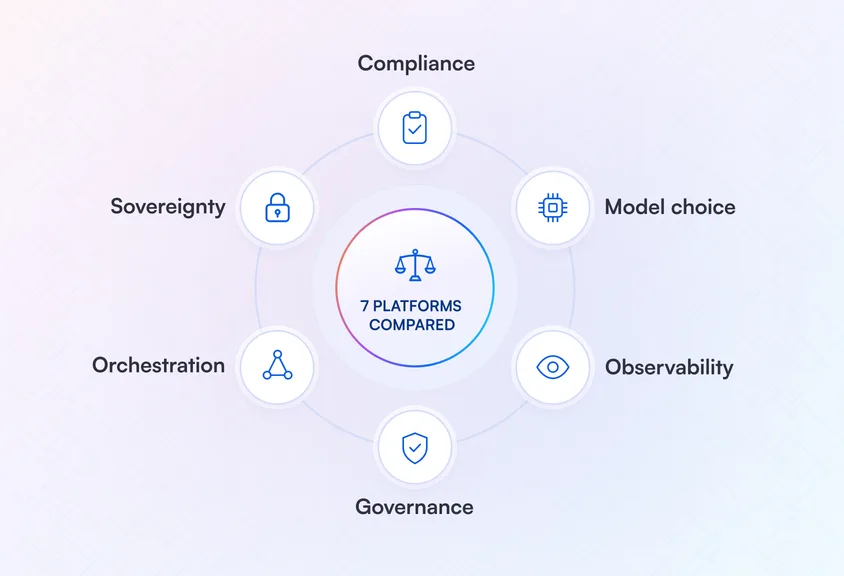
Enterprise AI buyers need to assess more than model performance: can the platform coordinate business workflows, recover from failures, and show what each agent did? If you are evaluating enterprise AI agent platforms, orchestration, governance, and operational visibility belong on the same shortlist.
MagOneAI by Magure brings those capabilities together in an enterprise agentic AI platform. This guide compares seven approaches to workflow orchestration, observability, governance, and deployment control, helping you assess options for large organizations, conglomerates, and focused departmental automation.
Use this comparison to build a shortlist around your workflows, existing infrastructure, and operating requirements. For regulated use cases, add the evidence and oversight requirements identified by your compliance and security teams.
Quick Guide: 7 Best AI Agent Platforms for Enterprises
- MagOneAI by Magure: Our pick for the best enterprise agentic AI platform for governed workflow automation, model flexibility, and deployment control.
- Amazon Bedrock AgentCore: Managed AWS services for running, connecting, and observing production AI agents.
- Microsoft Foundry: Enterprise AI development environment with agent lifecycle management, model access, and governance integrations.
- Google Vertex AI (Gemini Enterprise Agent Platform): Data-centric agent tooling tied to BigQuery and Google Workspace for analytics-heavy regulated teams.
- CrewAI: Open-source multi-agent framework with role-based collaboration for teams with dedicated Python engineering capacity.
- n8n: Workflow automation that combines defined process steps, AI agents, and human decisions, with cloud and self-hosted options.
- IBM watsonx: AI platform with governance-oriented features for financial services and healthcare organizations navigating model risk management.
How We Chose the Best AI Agent Platforms for Enterprises
We selected these platforms to compare how different approaches address enterprise workflow automation, deployment control, and operational oversight. Your engineering, operations, security, and procurement teams need evidence that a platform fits production requirements. The criteria below provide a framework for that review rather than a numerical test score.
- Governance and audit readiness: Can the platform produce an immutable record of every agent action, tool call, and decision for a regulator or internal auditor?
- Deployment sovereignty: Does it support private cloud, on-premise, or air-gapped deployment so your data, prompts, and model calls never leave your network perimeter?
- Workflow orchestration depth: Can it handle durable, multi-step, multi-agent workflows with parallel execution, conditional branching, and human approval gates?
- Observability and cost attribution: Does the platform trace every execution step with latency, token usage, cost breakdowns, and replayable run histories?
- Compliance certifications: Does the vendor hold relevant third-party certifications such as ISO 42001, ISO 27001, SOC 2 Type II, or regional AI governance credentials?
- Model flexibility: Can you route across multiple LLM providers and swap models per agent without rebuilding workflows or accepting vendor lock-in?
The 7 Best AI Agent Platforms for Enterprises
This comparison covers several approaches to enterprise AI agents: orchestration platforms, cloud-managed agent services, and workflow automation platforms with agent capabilities. We compare them against the same business requirements while distinguishing what each platform provides.
1. MagOneAI by Magure: Best Overall AI Agent Platform for Enterprises and Large Organizations
MagOneAI by Magure is our pick for the best enterprise agentic AI platform for organizations seeking governed workflow automation and control over their deployment. Its combination of durable execution, model flexibility, and operational oversight supports production use cases across enterprises and large organizations.
As an agentic AI orchestration platform, MagOneAI brings multi-agent coordination, human oversight, and observability into one environment. Your team can define structured workflows, select supported models, and connect business systems while keeping responsibility for execution and review clearly assigned.
MagOneAI serves banks, government organizations, and mid-market businesses automating work through agentic AI workflows. Enterprise governance capabilities support these deployments without limiting the platform to large organizations or excluding teams starting with a focused automation use case.
The platform supports deployment on your own infrastructure, including private cloud, on-premise, and air-gapped environments. Data residency depends on the complete configuration: using an external model endpoint requires assessing where prompts and responses are processed, while isolated deployments require models and dependencies within the approved environment.
Workflows are composed on a visual canvas with Agent, Super Agent, A2A Agent, Tool, API, Code, Parallel, Condition, Guardrail, Intelligent Router, Human Task, Use Case, and ForEach nodes. ORBY helps you build and edit workflows from a prompt or an attached document. Each workflow runs on Temporal-backed durable execution, which means it survives crashes, restarts, and outages without losing state. Human approval gates pause execution until a designated person signs off, keeping high-stakes decisions under human judgment.
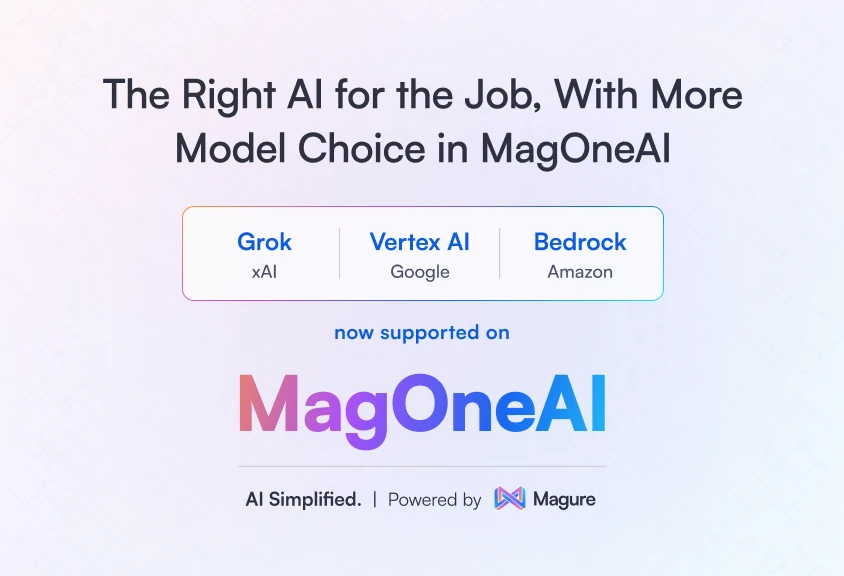
MagOneAI supports OpenAI, Anthropic, Gemini, Grok, Amazon Bedrock, Google Vertex AI, and self-hosted OpenAI-compatible endpoints. Azure OpenAI connects through an OpenAI-compatible configuration. You can select models per agent while keeping workflow design under your control.
HashiCorp Vault manages credentials. Ten built-in integrations, a growing catalogue of external MCP servers, and an API node connect workflows to business systems. Available connections include HubSpot and Oracle Fusion; other systems can connect through a compatible MCP server or API integration.
Magure holds triple ISO certification: ISO 42001 for AI management, ISO 27001 for information security, and ISO 9001 for quality management, plus SOC 2 Type II, GDPR compliance, and the Dubai AI Seal. These are third-party audited certifications, not self-declared badges.
MagOneAI Features
- Sovereign deployment: Private cloud, on-premise, or air-gapped, keeping your data inside the perimeter your regulator approved.
- Deterministic orchestration: Temporal-backed durable execution with parallel branches, schema-validated outputs, and replayable state for every run.
- Configurable access control: magauth combines roles, groups, resource-scoped grants, and per-user overrides, with explicit denies taking precedence. Enforcement settings must be reviewed for your deployment. OpenID Connect supports enterprise SSO.
- Execution visibility: Execution records, per-activity logs, and token and cost reporting help you investigate workflow behavior. Detailed agent trajectory capture is opt-in; retention and capture settings should match your evidence requirements.
- Source-grounded knowledge: Enterprise RAG supports hybrid retrieval and source citations for document, SharePoint, and web sources. Database tools do not produce citations. Guardrail and Human Task nodes let you design validation and escalation paths for higher-stakes outputs.
- Flat Predictable Pricing: A platform subscription avoids separate charges for each execution, agent, or user. Model usage and infrastructure remain part of your operating budget. Bundled orchestration, governance, and observability strengthen value by reducing the components your team needs to assemble and maintain.
MagOneAI Pros and Cons
Pros:
- Sovereign deployment options include on-premise and air-gapped environments using private models, so you can design data processing around your approved network boundaries.
- Triple ISO certified (42001, 27001, 9001) plus SOC 2 Type II, providing auditable proof of governance for procurement and regulatory reviews.
- LLM-agnostic orchestration lets you swap models per agent without rebuilding workflows.
- Flat Predictable Pricing combines orchestration, governance, and observability without separate execution, agent, or user charges. This supports a favorable total-cost case as adoption expands, with model and infrastructure costs assessed separately.
- Compatibility with AWS Bedrock and Azure AI lets you retain existing model investments while using MagOneAI for orchestration on your own infrastructure.
Cons:
- Customer-managed deployments need infrastructure planning; managed hosting and Enterprise Edition deployment options provide alternative operating arrangements.
- Niche or legacy systems may need a compatible external MCP server or custom API integration alongside the built-in integrations and external catalogue.
2. Amazon Bedrock AgentCore: Managed Infrastructure for Production AI Agents
Amazon Bedrock AgentCore provides managed AWS services for running, connecting, and observing AI agents. Your team can bring agent code built with supported frameworks and models while using AWS infrastructure for production execution.
AgentCore supports tool connections, authentication, access controls, and observability. Its role in this comparison is managed agent infrastructure rather than a direct equivalent of a visual orchestration platform.
Amazon Bedrock AgentCore Features
- Runtime services: Managed infrastructure for agent applications built with supported models and frameworks.
- Tool connectivity and identity: Connections to APIs, MCP servers, and AWS services with authentication and access controls.
- Agent observability: Traces and production telemetry help teams inspect model interactions and tool calls.
Amazon Bedrock AgentCore Pros and Cons
Pros:
- Supports existing agent frameworks and model choices.
- Connects agent operations with AWS security and infrastructure services.
- Provides services for agent runtime, identity, memory, and observability.
Cons:
- Managed services run within AWS rather than being installed on infrastructure of your choice.
- Application-specific orchestration and recovery behavior still need to be designed and tested.
- Architecture and cost evaluation require considering the individual services an application uses.
3. Microsoft Foundry: Enterprise AI Development and Agent Lifecycle Management
Microsoft Foundry is an enterprise AI platform for building, grounding, deploying, and governing AI applications and agents. Its services include models, agent development, tools, and a control plane for operational oversight.
Foundry connects with Microsoft's identity, security, and data services. It supports agent lifecycle management and production tracing, making it a broader AI development environment rather than only a model-access service.
Microsoft Foundry Features
- Agent development: Services and frameworks for building and hosting AI agents.
- Governance integrations: Connections with Entra, Purview, and Defender support identity and security oversight.
- Observability: OpenTelemetry-based tracing and evaluators support monitoring and investigation of agent behavior.
Microsoft Foundry Pros and Cons
Pros:
- Brings model access, agent services, and governance into a shared environment.
- Connects with Microsoft's enterprise identity and security services.
- Supports custom tools, external knowledge sources, and open protocols.
Cons:
- Building with Foundry requires an Azure subscription.
- Individual services and features have their own billing models.
- Architecture evaluation needs to account for the dependencies and controls of the specific services selected.
4. Google Vertex AI (Gemini Enterprise Agent Platform): Data-Centric Agent Tooling for Analytics-Heavy Regulated Teams
Google rebranded Vertex AI as the Gemini Enterprise Agent Platform in April 2026, consolidating its agent tooling around the Gemini model family. The platform connects agent workflows directly to BigQuery, Pub/Sub, and Google Workspace, making it a natural fit for regulated organizations whose data infrastructure already lives in Google Cloud.
Agent Builder supports multi-agent setups with grounding through Google Search, and Gemini 4 Argon provides first-party multimodal capabilities. Deployment and scaling are fully managed within GCP.
Google Vertex AI Features
- First-party frontier model: Gemini 4 Argon (GA October 2026) with multimodal capabilities for processing mixed document, image, and structured data.
- BigQuery integration: Agent workflows query structured enterprise data directly within GCP, reducing data movement.
- Semantic governance policies: Plain-language policy rules that check each tool call an agent proposes before execution, enforced through Agent Gateway.
Google Vertex AI Pros and Cons
Pros:
- Native integration with BigQuery and Pub/Sub provides direct access to enterprise data without additional middleware.
- Gemini's multimodal capabilities handle mixed data types within a single workflow.
- Semantic governance policies let compliance teams write rules in plain language rather than code.
Cons:
- Deployment is restricted to GCP, limiting options for organizations with non-Google data residency or multi-cloud requirements.
- Agent Builder is maturing but does not yet match the orchestration flexibility of code-first frameworks for complex branching logic.
- OpenAI model access remains in private preview, limiting model selection compared to other hyperscaler catalogs.
5. CrewAI: Open-Source Multi-Agent Framework for Teams With Dedicated Engineering Capacity
CrewAI is an open-source Python framework for building collaborative multi-agent systems. Each agent receives a defined role, goal, and backstory, then collaborates within a shared workflow to complete larger objectives. The framework supports sequential and parallel execution, memory, and built-in tracing.
In October 2026, CrewAI launched the Agent Control Plane on its commercial platform (CrewAI AMP), adding runtime policies for PII redaction and cost limits. Enterprise Plan users can enforce organization-wide controls across deployments through the AMP dashboard.
CrewAI Features
- Role-based agent design: Assign responsibilities, goals, and delegation rules to individual agents for structured task coordination.
- Agent Control Plane: Runtime governance policies for PII redaction and cost limits, enforced across deployments on CrewAI AMP (Enterprise Plan).
- Python-first extensibility: Full customization of orchestration logic, tool integrations, and agent behavior for teams comfortable writing code.
CrewAI Pros and Cons
Pros:
- Open-source framework with an active community, allowing you to inspect and modify agent coordination logic directly.
- Role-based multi-agent collaboration maps naturally to how teams divide responsibilities across business processes.
- The Agent Control Plane on AMP adds runtime governance for teams ready to move from experimentation to controlled deployment.
Cons:
- Enterprise governance features like PII redaction policies require the paid Enterprise or Ultra Plan on CrewAI AMP.
- Production deployments require additional observability and security tooling beyond what the open-source framework provides.
- Four vulnerabilities (two with CVSS 9.8) were published by CERT/CC in March 2026, though CrewAI states all are fixed in current releases.
6. n8n: Workflow Automation With AI Agents and Human Oversight
n8n is a source-available workflow automation platform that combines deterministic steps, AI agents, and human decisions. Its visual builder connects business applications and lets teams add code where custom logic is needed.
AI Agent nodes operate inside workflows, while standalone Agents can reason across requests and use workflows as tools. These are distinct capabilities; the newer standalone Agents experience is documented as Preview, not the entire AI workflow capability.
n8n Features
- Workflow and agent coordination: Defined process steps can surround agent reasoning, and agents can call workflows as tools.
- Deployment choice: Cloud and self-hosted options support different operating arrangements. External model or API calls still need separate data-flow assessment.
- Operational controls: Execution history, human approval steps, and access-control options support oversight, with capabilities varying by deployment and plan.
n8n Pros and Cons
Pros:
- Combines business-system automation with agent reasoning in a visual environment.
- Supports self-hosting and custom code alongside integrations.
- Provides execution inspection and configurable human approval for sensitive actions.
Cons:
- Self-hosted deployments require an operating model for infrastructure, updates, and security.
- Standalone Agents are in Preview and should be evaluated separately from established workflow nodes.
- Governance and operational capabilities need to be checked against the selected edition and deployment configuration.
7. IBM watsonx: Governance-Oriented AI Platform for Financial Services and Healthcare
IBM watsonx targets regulated environments where explainability, model risk management, and policy enforcement are procurement requirements. The platform includes AI Factsheets that track model behavior over time, providing an auditable decision trail that financial regulators and healthcare auditors expect.
Multi-agent workflows connect to IBM's broader enterprise software stack, and the platform supports both IBM's own Granite models and third-party LLMs. The governance layer is one of the more mature in this category, though it comes with complexity and cost that reflect its enterprise positioning.
IBM watsonx Features
- AI Factsheets: Model lifecycle tracking that records training data, performance metrics, and decision rationale for regulatory audit trails.
- Policy enforcement: Built-in controls for model risk management, bias detection, and compliance monitoring within agent workflows.
- Multi-agent orchestration: Coordinated agent workflows that connect to IBM's enterprise data platforms and business applications.
IBM watsonx Pros and Cons
Pros:
- AI Factsheets provide a clear, auditable record of model decisions that maps to regulatory expectations in financial services and healthcare.
- Governance and policy enforcement features are built into the platform from the start, not added as extensions.
- IBM's existing relationships with regulated enterprises provide established procurement and support channels.
Cons:
- The platform's complexity and configuration requirements can extend initial deployment timelines for teams without IBM ecosystem experience.
- Developer experience and interface design are less modern compared to cloud-native agent platforms.
- Organizations not already invested in IBM's software stack face additional integration work to connect non-IBM systems.
Comparison Table: AI Agent Platforms for Enterprise Evaluation
| Platform | Approach represented in this comparison | Evaluation focus |
|---|---|---|
| MagOneAI | Enterprise agentic AI orchestration platform | Durable workflows, deployment choice, governance, and model flexibility |
| Amazon Bedrock AgentCore | Managed cloud agent infrastructure | Runtime, tool connectivity, identity, and observability on AWS |
| Microsoft Foundry | Enterprise AI development and agent platform | Models, agent lifecycle, grounding, and governance integrations |
| Google Vertex AI | Cloud AI development and agent tooling | Agent development alongside Google Cloud data services |
| CrewAI | Multi-agent framework and commercial platform | Code-based agent coordination and operational controls |
| n8n | Workflow automation with agent capabilities | Combining deterministic processes, agent reasoning, and human decisions |
| IBM watsonx | Enterprise AI platform with governance capabilities | Model lifecycle, governance, and enterprise integration |
What Should You Look For in an Enterprise Agentic AI Platform?
An enterprise agentic AI platform should fit your deployment boundaries, workflow requirements, and oversight model. MagOneAI supports sovereign deployment across customer cloud and on-premise environments, including air-gapped configurations with private models. Assess model endpoints and connected tools alongside the platform itself.
Next, check the audit trail. Compliance teams need to reconstruct what an agent did, which tools it called, what data it accessed, and what decision it made, for every single execution. If the platform cannot produce that record in a format your auditor accepts, governance becomes a manual documentation exercise rather than an architectural property.
Finally, evaluate model flexibility. Your preferred provider can change as security requirements, costs, and performance evolve. An agentic AI orchestration platform should let you coordinate supported models while retaining control over workflow design. MagOneAI supports model selection per agent, including cloud-hosted and private endpoints.
How Does AI Governance Differ From Traditional IT Governance?
Traditional IT governance focuses on who can access a system and what changes they can make. AI governance adds a new dimension: the system itself makes decisions, and those decisions need to be explainable, reproducible, and attributable to specific inputs.
According to IDC's 2026 MarketScape on Agentic AI Platforms, 95% of organizations now have at least one agent workflow in production, yet most lack the governance infrastructure to manage those agents at scale. That gap grows when you operate in a regulated environment where model drift, hallucination risk, and data exposure carry direct penalty consequences.
The practical difference is that AI governance requires controls at the execution layer, not just at the access layer. You need to validate what an agent produces before it reaches a customer or a downstream system, and you need to retain a record of that validation for regulatory review.
How Does MagOneAI Work Alongside Your Existing AI Investments?
MagOneAI provides an agentic AI orchestration platform around your business use cases while allowing you to retain supported models and infrastructure. You can adopt a shared layer for coordination, governance, and observability without treating every existing technology investment as something to replace.
Already Using AWS Bedrock or Azure AI?
MagOneAI connects directly to Amazon Bedrock and supports Azure OpenAI through an OpenAI-compatible endpoint, so you can retain those model services while running the orchestration platform on your own infrastructure. Your team controls workflow design and coordinates supported models through a common layer rather than tying every workflow to one provider's agent runtime.
Connecting to a cloud-hosted model still involves that provider's service boundaries and charges. For workflows requiring strict network isolation, assess the model endpoint, data routes, and deployment configuration together.
Building an AI Platform Internally?
MagOneAI gives your engineering team an existing foundation for orchestration, security controls, and observability that they can customize around business requirements. This lets you focus engineering effort on AI use cases and integrations rather than building every platform capability independently.
Evaluate the internal-build alternative across development, operational support, governance, and ongoing maintenance. Use your own engineering estimates and deployment requirements rather than assuming a universal build timeline or cost.
Already Using LangChain, n8n, or CrewAI?
Existing framework investments do not automatically need to be discarded. Assess which agent logic, tools, and integrations you can retain or connect while MagOneAI provides the orchestration and operational controls required for your production workflows. Compatibility should be validated for your implementation rather than assumed for every framework component.
MagOneAI combines durable execution, configurable role-based access control, vault-backed credentials, and execution tracing. For example, an existing n8n automation can be invoked through a compatible MCP tool rather than being rebuilt in MagOneAI. Your evaluation can focus on how those controls support recovery, oversight, and troubleshooting across the workflows you intend to automate.
Working Within a Defined AI Budget?
Start with a focused workflow and compare the full cost of putting it into operation. MagOneAI combines platform capabilities under Flat Predictable Pricing without separate charges for each execution, agent, or user. Your team can reuse supported models and infrastructure while directing engineering effort toward business use cases.
Compare proposals against the same workload and include platform charges, model usage, infrastructure, integrations, and support. This provides a defensible value comparison without assuming one price applies to every deployment.
Why MagOneAI Is Our Pick for the Best Enterprise Agentic AI Platform
MagOneAI earns our recommendation through its combination of durable orchestration, deployment choice, and operational oversight. For enterprises and large organizations, those capabilities support a shared foundation for business automation across teams rather than isolated agent implementations.
MagOneAI brings orchestration, governance, and observability into one platform for banks, government organizations, and mid-market businesses. You can retain supported AWS Bedrock and Azure AI models while running the orchestration layer on your own infrastructure, with data routes assessed against your deployment requirements.
Temporal-backed durable execution supports workflow recovery, while audit trails and human approval gates provide operational oversight. Together, these capabilities strengthen the cost-value case by reducing the platform components your team needs to assemble and maintain independently.
MagOneAI connects governance architecture to operational controls: execution records, configurable access policies, human approval gates, and source-grounded retrieval. Guardrail nodes and workflow branches let you define how unsupported or blocked outputs are handled before they reach downstream systems.
Found this useful? Share it with your team.
Enterprise Agentic AI Orchestration Platform
FAQ
Frequently Asked Questions
- What is an enterprise AI agent platform?
- An enterprise AI agent platform lets you build, deploy, coordinate, and govern agents that execute business workflows. MagOneAI by Magure combines these capabilities in an enterprise agentic AI platform with durable execution, configurable oversight, and deployment options for enterprises, large organizations, and mid-market teams.
- Why do enterprises need an agentic AI orchestration platform?
- An agentic AI orchestration platform coordinates models, tools, workflow state, and human decisions across multi-step processes. MagOneAI combines these controls with execution visibility and architecture-level governance, helping your team operate connected AI workflows with defined oversight.
- Can you deploy AI agents on your own infrastructure?
- Yes. MagOneAI supports private cloud, on-premise, and air-gapped deployment. Keeping model calls within your perimeter requires private models and appropriately configured dependencies. Review every model endpoint and connected tool against your data sovereignty requirements.
- What certifications should an AI agent platform have for regulated use?
- Look for ISO 42001 (AI management), ISO 27001 (information security), and SOC 2 Type II as a baseline. Magure holds all three ISO certifications plus SOC 2 Type II, GDPR compliance, and the Dubai AI Seal, all verified by independent third-party auditors.
- How does MagOneAI handle AI hallucinations in regulated workflows?
- MagOneAI supports source-grounded retrieval and citations for document, SharePoint, and web content. These controls help reviewers assess supporting evidence but do not eliminate hallucinations. You can configure Guardrail nodes, validation steps, and human review for consequential outputs; database tools do not produce source citations.
- What is the difference between a managed cloud AI platform and a sovereign AI platform?
- A managed cloud platform runs on the vendor's infrastructure, giving you API access but limited control over data residency and network isolation. A sovereign AI platform like MagOneAI deploys inside your own environment, so your compliance and security teams control exactly where data lives and who can access it.